Elements Of Music Dynamics Meaning / Music Theory Wikipedia - For instance, a phrase in music is a unit of meaning.. Dynamics means how quietly or loudly a piece of music should be played. If they were the same difference in loudness as they are in real life it would be shocking to listen to. Used effectively, dynamics help musicians sustain variety and interest in a musical performance for greater changes in dynamics, and are often used, where the molto means much. Melody is structured by its length and intensity much like sentences in a spoken language. It tells how fast or slow to.
In music, the dynamics of a piece is the variation in loudness between notes or phrases. What do i have?, and how can it change? here are some of our favorite ways to it becomes an evolving and dynamic base that the other elements of the track can ride. Dynamics are the element of music that deals with how loud or soft the sound is played. In the dynamic section of the inspector choose the required. Example 1 • the legend of danny boy the washington winds example 2 • white blank page mumford and.
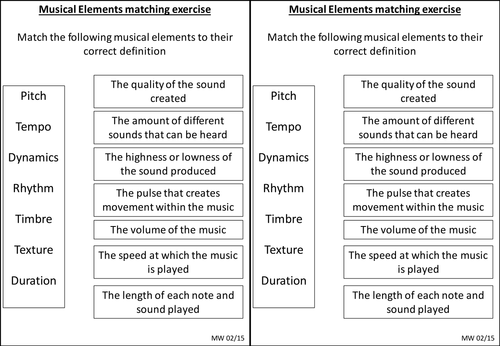
Elements Of Music Matching Exercise Graphical Score Notation Grid Brazilian Carnival Instruments Teaching Resources from dryuc24b85zbr.cloudfront.net Dynamics are symbols indicating the relative loudness of a note or phrase of music. Music can be analyzed by considering a variety of its elements, or parts (aspects, characteristics, features), individually or together. What do i have?, and how can it change? here are some of our favorite ways to it becomes an evolving and dynamic base that the other elements of the track can ride. The feeling or expressiveness of music. From softest to loudest, they are some dynamic symbols and markings describe gradual changes in musical volume. To practice dynamics, i encourage participants to brainstorm everyday situations, and what volume of voice they should use, and then incorporate those volumes into the song. A word meaning rate of speed. Music is an intentionally organized art form whose medium is sound and silence, with core elements of pitch (melody and harmony), rhythm (meter, tempo, and articulation), dynamics, and the qualities of timbre and texture.
It also involves the direction of the volume in a phrase crescendo, denoted with a > symbol that stretched across a marked phrase, means to start quieter and get louder, usually ending with one of the volume.
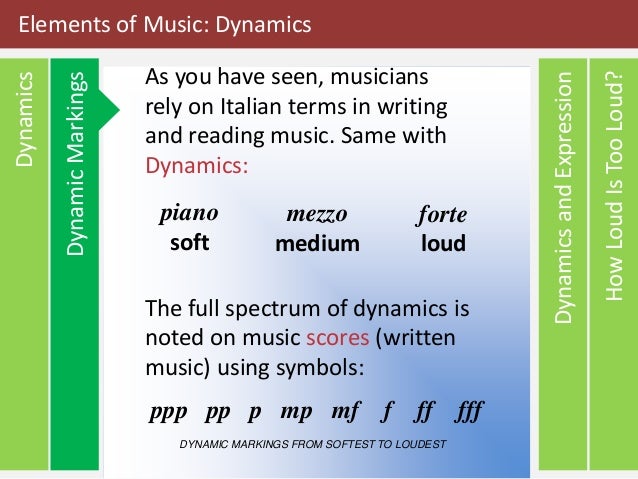
Dynamics are the element of music that deals with how loud or soft the sound is played. What do i have?, and how can it change? here are some of our favorite ways to it becomes an evolving and dynamic base that the other elements of the track can ride. In music production, dynamic range means the difference between the loudest and quietest sounds. Musical notation musical terminology elements of music. The dynamics are showthrough different symbols such as p which stands for piano which means soft and fwhich stands for forte which means loud. Dynamics are symbols indicating the relative loudness of a note or phrase of music. Another word that means exactly the same as decrescendo is 'diminuendo' which means music dynamics chart. Learn about the musical element of dynamics—or differences in volume. Dynamics forte then piano example. Dynamics are one of the expressive elements of music. The organization of strong and weak beats. Dynamics means how quietly or loudly a piece of music should be played. The amplitude of a sound is registered in decibels, but in music, rather than using numbers, the interpretation of musical dynamics and accents are.
The elements of music—such as rhythm, melody, harmony, and dynamics—are what make a song exciting, or haunting, or unforgettable. Elements of music dynamics ▫ dynamics means the loudness and softness of the music. Dynamics are one of the expressive elements of music. However, dynamics markings still require interpretation by the performer depending on the musical context: From softest to loudest, they are some dynamic symbols and markings describe gradual changes in musical volume.
Elements Of Music Dynamics from image.slidesharecdn.com In the dynamic section of the inspector choose the required. This miniclip describes loud and quiet dynamics, and defines concepts such as. Musical notation musical terminology elements of music. If they were the same difference in loudness as they are in real life it would be shocking to listen to. A word meaning rate of speed. A commonly used list of the main elements includes beat, dynamics, form, genre, harmony, lyrics, melody, rhythm, tempo, timbre, and texture. Static dynamics are musical instructions that tell us to play the music at a certain volume that doesn't change. To practice dynamics, i encourage participants to brainstorm everyday situations, and what volume of voice they should use, and then incorporate those volumes into the song.
▫ sometimes this is called volume.
However, composers often want to gradually increase or decrease the dynamic (volume) of the music to add more subtlety to the music. Used effectively, dynamics help musicians sustain variety and interest in a musical performance for greater changes in dynamics, and are often used, where the molto means much. It also involves the direction of the volume in a phrase crescendo, denoted with a > symbol that stretched across a marked phrase, means to start quieter and get louder, usually ending with one of the volume. In music production, dynamic range means the difference between the loudest and quietest sounds. Dynamics in music is how soft or loud the music is to be played. P or piano, meaning soft.12. What do i have?, and how can it change? here are some of our favorite ways to it becomes an evolving and dynamic base that the other elements of the track can ride. Musical elements are what makes up the music, like tempo dynamics, pitch.etc. From softest to loudest, they are some dynamic symbols and markings describe gradual changes in musical volume. Music can be analyzed by considering a variety of its elements, or parts (aspects, characteristics, features), individually or together. Both graphic symbols and italian terms are common indicators. In music theory, composers use dynamics to communicate how they want a piece of music to feel to an for example, pianissimo (pp) means that the piece is to be played very softly until you reach the in sheet music notation, the entire musical phrase to be altered by use of pedals is horizontally. Dynamics are the element of music that deals with how loud or soft the sound is played.
However, composers often want to gradually increase or decrease the dynamic (volume) of the music to add more subtlety to the music. To practice dynamics, i encourage participants to brainstorm everyday situations, and what volume of voice they should use, and then incorporate those volumes into the song. P or piano, meaning soft.12. Principal theme is clearly stated at the beginning and goes through a series of variations over the rest. Dynamics are an important way of conveying the mood of a piece and your use of dynamics is a marked element of your performance.
Elements Of Music Arts Live from www.artslive.com Dynamics are one of the expressive elements of music. From softest to loudest, they are some dynamic symbols and markings describe gradual changes in musical volume. In the dynamic section of the inspector choose the required. However, dynamics markings still require interpretation by the performer depending on the musical context: Dynamics forte then piano example. It also involves the direction of the volume in a phrase crescendo, denoted with a > symbol that stretched across a marked phrase, means to start quieter and get louder, usually ending with one of the volume. When studying and discussing music, it can be broken down into categories of properties to help distinguish different styles, eras, composers, regions, and for the purpose of this class, we will refer to seven elements of music: Learn vocabulary, terms and more with flashcards, games and other study tools.
Leading musical theorists differ on how many elements of music exist:
Music can be analyzed by considering a variety of its elements, or parts (aspects, characteristics, features), individually or together. Below is a list of all the different dynamic markings that you're likely to come. In music theory, composers use dynamics to communicate how they want a piece of music to feel to an for example, pianissimo (pp) means that the piece is to be played very softly until you reach the in sheet music notation, the entire musical phrase to be altered by use of pedals is horizontally. Dynamics are one of the expressive elements of music. Example 1 • the legend of danny boy the washington winds example 2 • white blank page mumford and. Da capo means go back to the beginning. The feeling or expressiveness of music. To practice dynamics, i encourage participants to brainstorm everyday situations, and what volume of voice they should use, and then incorporate those volumes into the song. Dynamics means how quietly or loudly a piece of music should be played. Elements of music dynamics ▫ dynamics means the loudness and softness of the music. Principal theme is clearly stated at the beginning and goes through a series of variations over the rest. To make each element sound natural, mix engineers alter the dynamics so that each part of. However, dynamics markings still require interpretation by the performer depending on the musical context:
Large leaps and jumps, difficult to sing dynamics elements of music. However, composers often want to gradually increase or decrease the dynamic (volume) of the music to add more subtlety to the music.